Market Review & Strategy
Unusually, equity markets traded to or near historic highs despite rising bond yields, elevated oil prices and extending inflation break-even indices.
The month of July saw a cathartic correction to semiconductor/memory chip stocks with growing investor angst around AI capex pay-offs, financing and the ultimate quantum of compute demand. The Philadelphia Semiconductor Index fell 21% in the month, with DRAM stocks losing 32% and neocloud names lower by ~ 20%. The retracement quickly embroiled the Korean share market with the KOSPI benchmark falling ~30% in the month (from its high), significant given it had been the globe’s premier stock market performer year-to-date.
Situational Awareness, a highly concentrated and leveraged US tech hedge fund would fall victim to the heightened volatility, only to receive a stay of execution courtesy of Ken Griffen’s Citadel LLC, which purchased much of the fund’s listed stock portfolio. This rescue mission, coupled with a de-escalation in the US-Iran conflict, had a calming effect on markets and allowed the S&P500 to ascend to historic highs by mid-August.
Undoubtedly the big story of the quarter was the back-up in global bond yields between June end and the close of the September quarter. Investors began to discount the inflationary impulse from higher energy prices, an increasingly hawkish tilt from central banks, elevated sovereign debt/budget deficits and the prospect of private sector crowding-out from hyperscaler bond issuance.
For the first time in 28 years the US Treasury, via its Exchange Stabilisation Fund, bought Japanese yen in concert with the Bank of Japan (BOJ) in the final days of July. Its purpose being to arrest the yen’s depreciation and reduce the exposure of US long bonds to BOJ liquidation (removing bond selling-pressure and therefore the upwards pressure on interest rates).
The US Federal Reserve voted unanimously to raise rates on September 16 to remove ‘a dose of accommodation’, in chair Warsh’s words.
The three months to September end was a busy period for Australian stocks, with the ASX200 attaining historic highs mid period. M&A announcements dominated news tickers with international suitors continuing their pursuit of underperforming ASX-listed companies.
Goldfields approached Northern Star Resources, Warburg Pincus bid for Ingenia, who themselves bid for Peet Limited. An EQT infrastructure fund bid for Cleanaway, Brookfield capital partners approached Reliance Worldwide (on 4 occasions since April and bettering the price with each proposal). Blackstone Singapore bid for IDP Education, OFX Group received a takeover approach from Equals Group and EQT bid (with subsequent top-ups) for Perpetual Limited. Three bidders reconfirmed their interest in acquiring Ooh Media!, with I Squared Capital entering into a scheme of arrangement in August. Consolidation of the novated leasing sector continued with four separate parties lodging takeover offers for Fleet Partners. Ares Management Corp moved on Maxitrans and several smaller resource company tie-ups were proposed or consummated during the quarter.
Equity capital markets activity was dominated by resource company raisings including the L1 Gold Fund raising $516m, Arafura RE $475m and KGL Resources $300m.
The local results season handed down in August slightly bettered expectations. A clear dichotomy emerged among ASX reporters-those exposed to the investment economy (AI capex, infrastructure and mining contractors) performed strongly and those with consumer exposures largely struggled and foresaw challenges ahead.
Alphabet Inc launched a AUD5.5bn corporate bond issue (est 3x bid coverage), Australia’s largest ever bond issue, marking the successful arrival of US tech companies to the kangaroo bond market and the likely forerunner to other bond issuance in the sector.
Technical Summary
Stocks/Bonds
Despite the S&P 500 flirting with historic highs, it appears the veracity of the advance has cooled somewhat, with lighter daily traded volumes and a distinct narrowing of market breadth. From mid-August the S&P 500 equal-weight benchmark has conceded ground to the market-weight index, the former being the trailblazer through 2026. Anecdotes suggest that new lows on the NYSE are at the highest levels since April 2025, underscoring the reduced breadth of the recent rally. Since August 11, trader positioning in the E-Mini Index futures has been increasing to the short side.
A bearish rising wedge formation is configuring in both the S&P 500 and 100, suggestive of a modest quenching to share prices might be close at hand.
The Bloomberg Mag 7 Price Index has benefited from the price reset that occurred in June and has traded strongly since this time. It too is configuring into a rising wedge and appears to be tiring.
The Russell 2000 today sits nicely on the support line of a bullish uptrend channel in train since early 2025. It is important that this channel holds.
Locally, the All Ordinaries Index having failed in its attempts to clear 9425 on multiple occasions over the past 12 months is now probing the downside. With the investment line (aka the 100 day moving average) tracking sideways, investors will be banking on the index holding a support line originating from the covid lows.
The S&P/ASX Small Ordinaries has continued to trade lower and at the time of writing was closing in on important support from March 2020. The S&P/ASX Mid Cap 50 Index also finds itself similarly positioned.
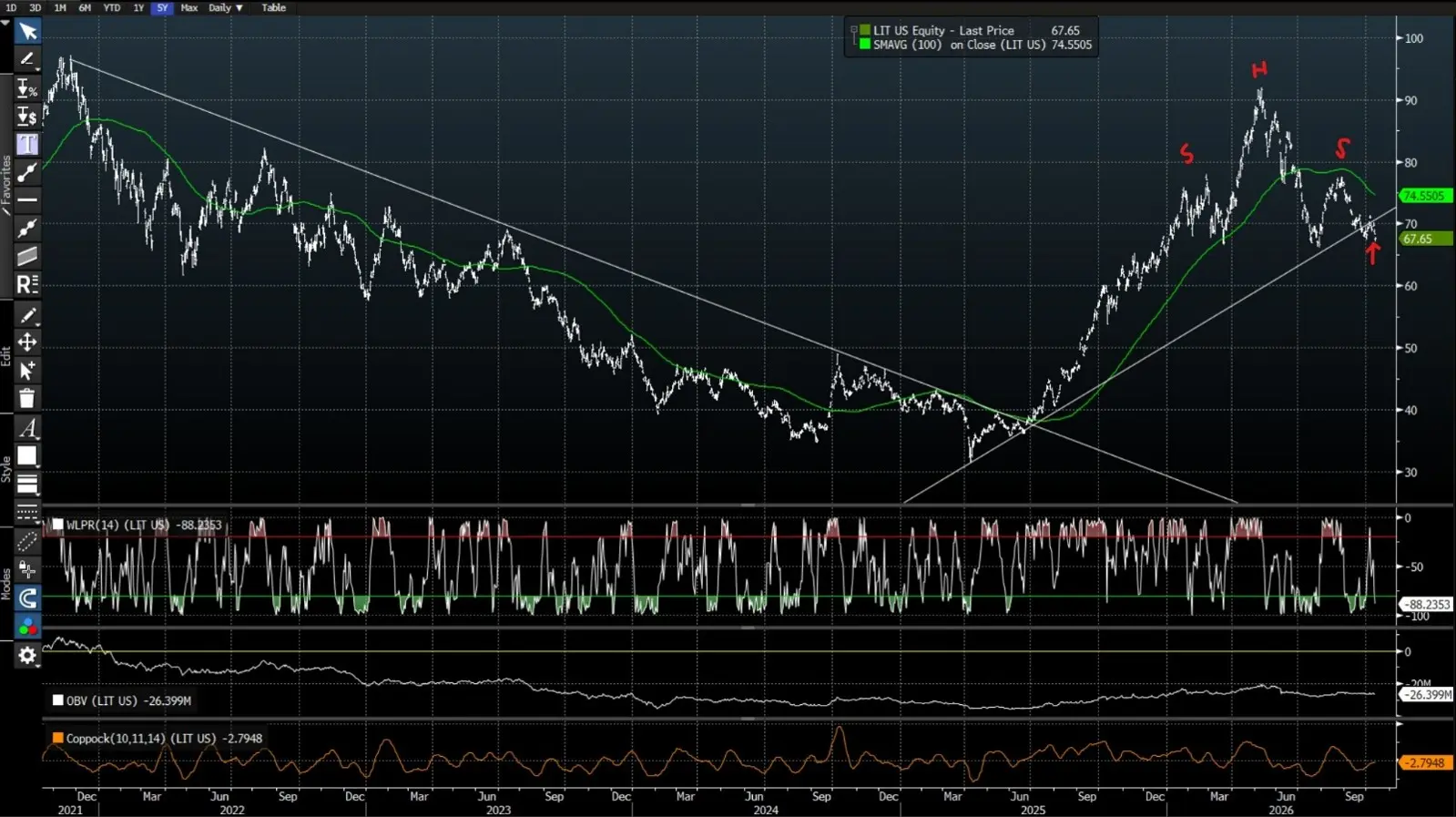
It is interesting to observe the set-up taking shape in the lithium market. The Lithium X Lithium & Battery Tech ETF, a fund comprising leading global lithium mining/battery equities, is in the throes of completing a textbook exhaustion pattern. The decisive rally from depressed levels April 2025 saw a high in early May and an ensuing correction in prices. The chart highlights the return to uptrend, the break and failing return move-all negative developments. Further, this has occurred within a head and shoulders topping pattern (as marked), with a neckline at 66.3. This chart appears set for downside price action.
Source: Bloomberg (October 2026)
Commodities/Currencies
Our incredulous commentary on Brent prices (‘approaching any rally in oil prices carefully’) coming into early July proved too conservative as the commodity found buyer interest well above support and rallied through the quarter. Momentum is squarely on side with crude and similarly with global oil equities that are making historic highs every other night. Futures speculators are modestly net long, as they were at prior quarter end, and this is a satisfactory setting for a continuing rally. The line of least resistance appears to be to the upside for crude right now, a certain pointer to firmer prices.
Gold’s break in early August ushered in a spirited rally, only to be curtailed by a Fibonacci resistance level (of the 2026 correction from US$5595/oz highs). Price action has been apathetic since that time and seems set on a return to US$3900/oz, where buyers resolve will be critically tested. The investment line is trending downward and set to suppress any low-conviction counter trend moves. Futures positioning is a notch longer than at the previous quarter end at 7:1 (long:short) and not likely to provide a buy-side fillip. Bullion (including the PGMs) is not ready to rally and will require investor patience in the short term anyway.
Last Encyclical we noted the arrival of buyer support for the Bloomberg Galaxy Crypto Index on or around where they were anticipated. A line of support that originated from the ashes of the covid sell-off in early 2020 has reliably guided the currency since this time and chimed in in June. The resultant bull drive is now pausing after a circa 40% advance. Prices will need to hold here for the bull case to prevail.
The Log – Will AI make Finance Theory a Practical Reality
Rapid advancements in the capability of Artificial Intelligence (AI) have seen disruption across several industries. For example, the mathematics community is facing an existential crisis after it was claimed that AI solved the Navier-Stokes problem[i], which was one of seven problems each carrying the USD 1m Millennium Prize.
Putting aside the controversy of whether AI leveraged the unpublished work of two mathematicians, the development raises two important philosophical problems. As Terence Tao[ii], who is arguably Australia’s most successful mathematician, has discussed 1) If mathematics is about to advance so rapidly that only very few mathematicians will be capable of understanding the maths produced by AI, will that type of “progress” benefit anyone, let alone society at large? and 2) Will future generations of mathematicians be discouraged from entering the field if the traditional “blood sweat and tears = reward” code no longer applies, thereby further compounding problem #1?
These are not small questions, and they apply to many areas, including mathematics’ aspiring stepchild, quantitative finance.
Ever since Markowitz showed (mathematically) that optimal portfolios existed in theory[iii], traditional stock picking has gradually been forced to produce outcomes more in line with those recommended by quantitative finance. Think efficient frontiers, risk-adjusted returns and performance attribution.
Indeed, after Markowitz, came Sharpe’s Capital Asset Pricing Model (CAPM)[iv] and a wave of asset pricing theory but also a growing counterculture, which highlighted that the theory often failed miserably when it came to practical implementation. The problem was that the theory required assumptions that simply failed in the messy world of real markets. Here are two examples (there are many more) that highlight the point: 1) Naïve optimisations produce suboptimal results because they are ignorant of things like turnover and estimation error[v]. 2) High-beta stocks tend to underperform low-beta stocks on a beta-adjusted basis, contrary to CAPM’s predictions.
Quantitative finance’s response was to relax the assumptions and band-aid the remaining wounds with empirical horsepower. Sharpe moved beyond his own CAPM to the more general pricing-kernel framework derived from state-preference theory, in which the CAPM is a special case, while Fama and French added factors to it[vi].
When it comes to empirical horsepower, AI is the ultimate. Questions that used to take a quant hours can now be answered by AI in minutes with the right prompting.
So, will AI make Finance Theory a Practical Reality? Like an econometrician who doesn’t require sleep, it will probably get ideas that work in theory to work in practice better than they ever have before. But the major issue will be whether AI agents will become better than humans at predicting the future. The recent geopolitically driven volatility has been a hard test for models calibrated on historical data, while some investors have navigated the turning points well using their expertise. A reminder that human judgment still matters.
As for the comparison to what’s happening in the maths community, finance has been in a similar spot before. In the lead-up to the GFC, quantitative models, especially for derivatives, were often seen as infallible and relied upon to reduce risk even though many people using them didn’t understand them fully. We all know how that ended. And as for whether future generations will be discouraged from entering the investment industry, it is probably unlikely given the rewards on offer – especially if they believe they can employ AI better than others to outperform. Hopefully, juniors who let AI run their back tests still develop the judgment required to build robust models that outperform.
Outlook
“In euphoria, any company can raise capital” opines revered UK fund manager, John Armitage of Egerton Capital in a recently recorded podcast[vii]. Er… not so, if the events surrounding the failed IPO of Firmus Technologies are anything to go by.
In the June quarter issue of The Encyclical we suggested the company’s pending float would be a ‘good test of market vitality’. It has now become apparent that retail investors failed to engage and both local and international long-only’s/hedge funds stood back for a laundry list of reasons. The response couldn’t be more different from that which greeted the IPO of SpaceX back in early June. Simply put, we may have just witnessed a sentiment shift from investors.
It is interesting to observe several important structural changes presently under way.
First, the US 10 year bond is now higher than the earnings yield of the S&P500, for the first time since 2001. This indicates the evaporation of the equity risk premium (depending upon how one calculates it) and is an important marker for tactical asset allocators. Essentially the inducement to buy stocks over bonds has disappeared.
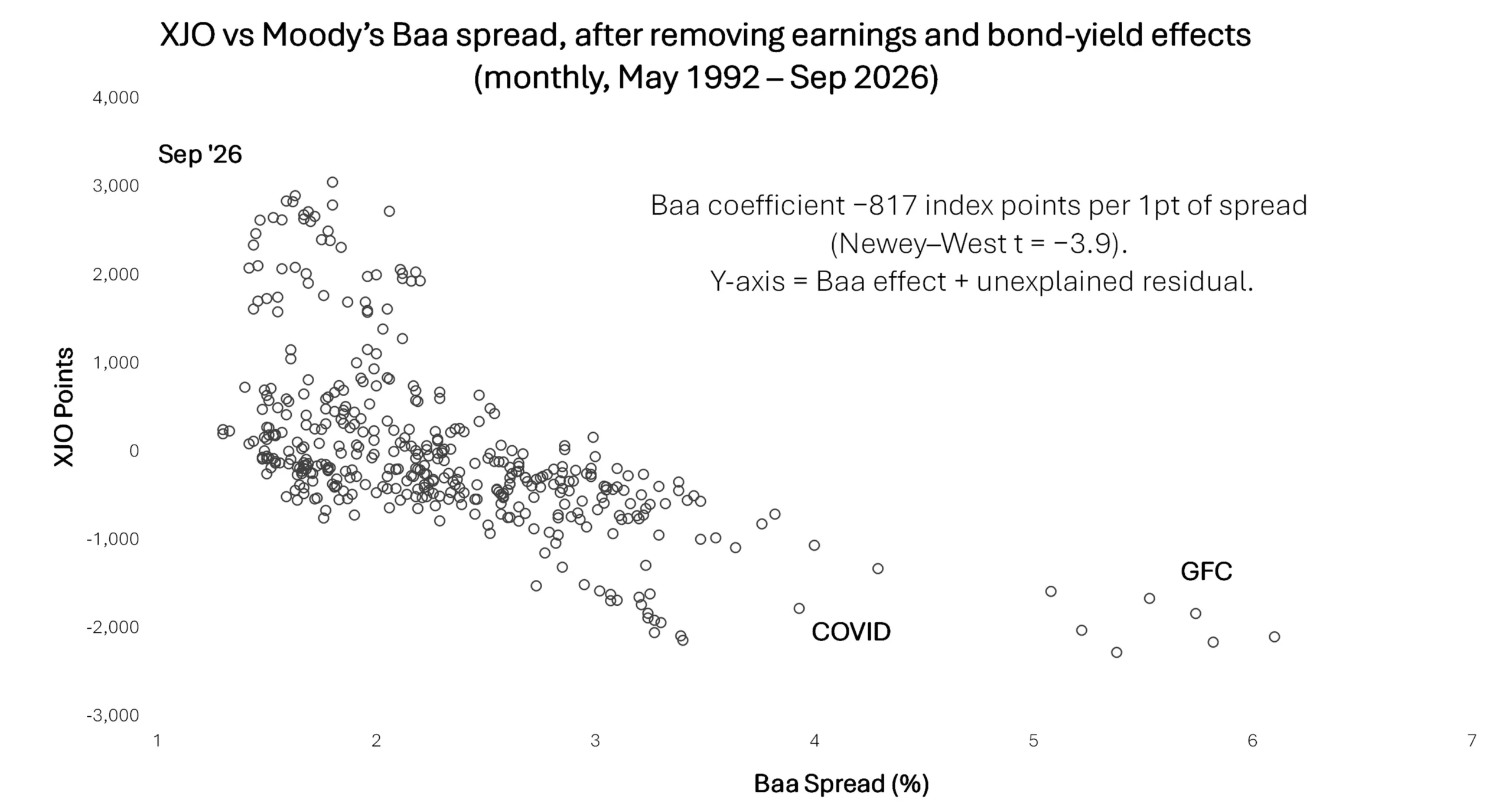
Second, The Encyclical has long decreed the importance of benign US credit spreads as a critical precondition of stock market health. Spreads (versus US 10 year bonds) on non-investment grade US debt (Caa/CCC or below) have been widening at pace since March this year. This level of investor angst is not yet observable in the BBB/Baa investment grade spreads, but this should be closely monitored.
Influenced by a research piece by Michael Knox of Morgans Financial, we analysed the effect Moody’s US Baa spread had on the level of the S&P/ASX200, as depicted in the below chart. It highlighted that the spread was statistically significant alongside local earnings and interest rates.
Source: Factset, EGG
Third, traders should also take note of the recent pricing of credit default swaps (aka debt insurance) for Oracle, Broadcom, CoreWeave and SpaceX, as each has moved appreciably higher since mid-September, extending from existing upward trajectories.
Markets are entering an important phase, having largely traversed the seasonal weak trading period of August-October with no shortage of variables for investors to ponder.
US companies are forecast to report an ox-strong Q3 reporting season, which is widely expected among the investing class. It would be fair to suggest that higher bond yields leave less room for earnings disappointment.
Abutting the season will be the US midterm elections on November 3 and for Australian investors we will be well into the teeth of the annual general meeting season, a timely disclosure point for how companies have been trading.
Finally, small company investors should note the S&P/Small ordinaries Index PE discount to the S&P/ASX100 of 11% is the deepest since the global financial crisis with a comfortably higher dividend yield (ex-franking) on offer.
Disclaimer
This document contains general market commentary prepared by Eley Griffiths Group Pty Limited (ABN 66 102 271 812, AFSL 224 818) (EGG). It is not independent research. References to specific securities, issuers, indices, sectors or strategies are for general information only and do not constitute a recommendation to buy, sell or hold any financial product. Information contained in this report is derived from the authors observations and interpretations of market events, public announcements and various stock exchange news releases. These will be typically sourced from data vendors, news wires and the wider financial press unless specifically attributed in the text or footnotes.
EGG, its related bodies corporate and/or their respective directors and employees may from time to time hold interests in, or transact in, securities or other financial products referred to in this document.
The information is intended for wholesale clients within the meaning of section 761G or 761GA of the Corporations Act 2001 (Cth) (Corporations Act) and must not be made available to any persons that are “retail clients” for the purpose of the Corporations Act.
The information is current as at the date of preparation and is subject to change. The information does not consider the investment objectives, financial situation, or particular needs of any individual. Before making an investment decision, you should consider obtaining professional investment advice that considers your personal circumstances and read the relevant disclosure document to determine whether an investment is right for you.
EGG has obtained information from sources it considers to be reliable, but does not represent that such information is accurate or complete, or that it should be relied upon. EGG makes no representations or warranties, express or implied, as to the accuracy or completeness of the information it provides and to the maximum extent permitted by law, neither EGG nor its directors, employees or agents accept any liability for any loss arising in relation to this information.
This document may not be reproduced or copies circulated without prior authority from EGG.
Any opinions, forecasts, estimates or projections reflect judgments of EGG as at the date of this document and are subject to change without notice. EGG does not guarantee repayment of capital or any particular rate of return. An investment may achieve a lower-than-expected return and investors risk losing some or all of their principal investment. Any forecasts, estimates or projections as to future returns should not be relied on, as they are based on assumptions which may or may not ultimately be correct. Actual returns could differ significantly from any forecasts, estimates or projections provided. Past performance is no indication of future performance.
[i] Source: OpenAI (2026), ‘On the Navier–Stokes Millennium Prize Problem’, 8 September. Available at: https://openai.com/index/navier-stokes-solution/
[ii] Source: Tao, T. (2026), ‘Terence Tao on AI in mathematics (and beyond)’, last updated 16 October. Available at: https://teorth.github.io/tao-web/ai-views.html
[iii] An optimal portfolio being one which maximises expected return for a given level of volatility. Source: Markowitz, H. (1952), ‘Portfolio Selection’, The Journal of Finance, 7(1), pp. 77–91.
[iv] The CAPM was independently developed by others including Lintner, Treynor and Mossin. Source: Perold, A.F. (2004), ‘The Capital Asset Pricing Model’, Journal of Economic Perspectives, 18(3), pp. 3–24.
[v] Estimation error can be thought of as errors in the forward-looking model inputs due to finite data.
[vi] Other examples of empirical band-aids include shrinkage, econometric market impact models and replacing bell curves with whatever fits the data, including so-called non-parametric distributions.
[vii] Source: In Good Company with Nicolai Tangen, Podcast, 7 October 2026